You want to understand how audio systems work. You want the science behind sound. This post gives you that foundation.
Understanding sound fundamentals helps you understand why systems work the way they do. You make better decisions. You understand technical discussions.
This post covers all the physics: sound waves, frequency, amplitude, phase, harmonics, decibels, impedance, power, and acoustics. Everything you need to understand the science behind audio systems.
This explains the science simply so you understand why systems work.
Future posts build on this foundation. They cover electronics (balanced audio, ground loops), connectors (XLR, TRS, and more), and troubleshooting.

Sound travels in waves. Here's how.
What is sound?
Sound is waves moving through air. Your ears hear these waves.
How sound travels:
Sound needs a medium like air, water, or solid objects. Waves move through these materials.
Wave motion:
Waves move outward like ripples in water, spreading from the source.


Complete guide to audio connectors: XLR, TRS, TS, RCA, Phoenix, Dante, and more. When to use each and how to convert between types.

Learn about balanced audio, ground loops, and troubleshooting. Builds on physics foundation. Understand electronics in audio systems.

Plan your business audio system with this complete guide. Works for restaurants, salons, retail, offices, bars, cafes. Budget, zones, system types.
Frequency (Pitch)
What: How fast waves move.
Higher frequency: Higher pitch (like a bird chirp) with more waves per second.
Lower frequency: Lower pitch (like a drum) with fewer waves per second.
Frequency measured in hertz (Hz). One hertz = one wave per second.
Human hearing: 20 Hz to 20,000 Hz. Below 20 Hz is infrasound. Above 20,000 Hz is ultrasound.
Wavelength
What: Distance between wave peaks.
Higher frequency: Shorter wavelength.
Lower frequency: Longer wavelength.
Why it matters: Wavelength affects how sound behaves in rooms.
Speed of Sound
What: How fast sound travels through air.
At room temperature (20°C): Sound travels at 343 meters per second (1,125 feet per second).
Why it matters:
Speed affects timing. Sound takes time to travel. Distance matters for delay calculations.
Example:
Speaker 10 feet away. Sound takes about 9 milliseconds to reach you. Account for this in system design.
This knowledge helps with delay calculations and speaker placement.
Wave Equation
Simple relationship:
Speed = Frequency × Wavelength
Written as: v = fλ
What it means:
Why it matters:
Higher frequency = shorter wavelength. Lower frequency = longer wavelength. This affects how sound behaves in rooms.
This equation helps understand room acoustics and speaker design.
Amplitude (Volume)
What: How big the waves are.
More amplitude: Louder sound. Bigger waves.
Less amplitude: Quieter sound. Smaller waves.
Amplitude measured in decibels (dB). See decibel section below for details.
Wave Propagation
How sound moves:
Sound spreads in all directions. Like a balloon expanding. It gets weaker as it travels.
Distance matters:
Sound gets quieter with distance. Double the distance = 6 dB quieter.
Why it matters:
Understanding frequency, amplitude, and wavelength helps you understand:
This knowledge is the foundation for system design.
Phase matters. Harmonics matter. Here's why.
Phase
What: Where a wave is in its cycle.
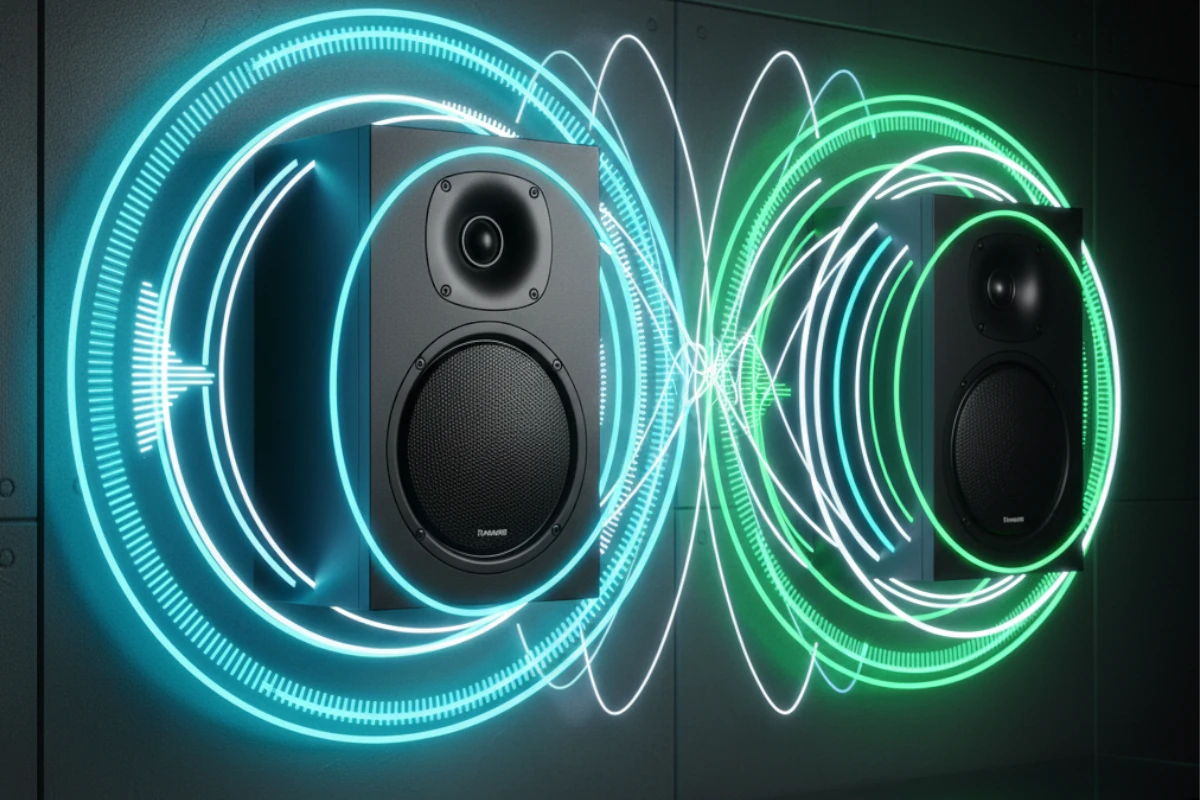
In phase: Waves line up and add together, creating louder sound.
Out of phase: Waves cancel and subtract, creating quieter sound.
180 degrees out of phase: Complete cancellation results in no sound.
Why phase cancellation works:
Waves add together. In phase means waves add. Out of phase means waves subtract. At 180 degrees, complete subtraction results in no sound.
Simple math:
Two waves with the same amplitude, 180 degrees apart, cancel each other. Net result: zero.
This knowledge helps prevent cancellation problems.

Why it matters:
Phase affects sound. Multiple speakers can cancel each other. Proper placement prevents this.
Harmonics and Overtones
What: Additional frequencies that come with the main frequency.
Fundamental frequency: The main pitch you hear.
Harmonics: Multiples of the fundamental. 2x, 3x, 4x, etc.
Relationship:
If fundamental is 100 Hz:
Overtones: All frequencies above the fundamental. Includes harmonics.
Why it matters:
Harmonics give sound its character. A guitar sounds different from a piano. Same note. Different harmonics.
This knowledge explains why instruments sound different.
Interference
What: When waves interact.
Constructive interference: Waves add. Louder.
Destructive interference: Waves cancel, creating quieter sound.
Why it matters:
Interference affects sound in rooms. Design systems to minimize problems.
This knowledge helps place speakers correctly.
Decibels measure sound. Here's how.
What are decibels?
Decibels measure sound level. It's a logarithmic scale. Not linear.
Why logarithmic?
Our ears hear logarithmically. Small dB changes sound big.
3 dB rule:
+3 dB equals twice the power but sounds barely louder.
+10 dB equals ten times the power and sounds twice as loud.
Sound Pressure Level (SPL)
What: How loud sound is at a point.
Measured in decibels (dB SPL).
Common levels:
Why it matters:
Design systems for appropriate levels. Too loud hurts ears. Too quiet doesn't work.
This knowledge helps set volume levels.

Power and Decibels
Power doubling:
Double the power = +3 dB. Not twice as loud.
Why it matters:
You need 10x power to sound twice as loud. Amplifiers need headroom.
This knowledge helps size amplifiers correctly.
Frequency response matters. Impedance matters. Here's why.
Frequency Response
What: How a system responds to different frequencies.
Flat response: All frequencies play equally. Ideal.
Roll-off: Some frequencies play quieter. Common at extremes.
Why it matters:
Frequency response affects sound quality. Choose components with good response.
Measured in hertz (Hz). Range the system can reproduce.
Human hearing range: 20 Hz to 20,000 Hz.
Speaker range: Usually narrower. Depends on speaker type.
This knowledge helps match components.

Impedance
What: Resistance to electrical current. Measured in ohms (Ω).
Speaker impedance:
Common values: 4Ω, 8Ω, 16Ω. Lower = easier to drive.
Why it matters:
Amplifiers must match speaker impedance. Mismatch causes problems.
This knowledge helps match amplifiers to speakers.
Acoustic Impedance
What: Resistance to sound waves. Different from electrical impedance.
Formula: Z = ρc
What it means:
Why it matters:
Affects how sound moves from speaker to air. Affects how sound reflects. Important for speaker design.
This knowledge helps understand speaker-room interaction.
Power and Wattage
What: How much power a system uses.
Watts: Unit of power.
RMS power: Continuous power. Real rating.
Peak power: Maximum power. Short bursts.
Why it matters:
Size amplifiers for RMS power. Peak power is marketing.
This knowledge helps choose amplifiers.
Power Calculations
Basic formulas:
What it means:
More voltage = more power. More current = more power. Lower resistance = more power (for same voltage).
Why it matters:
Calculate power needs. Size amplifiers correctly. Prevent overload. Ensure proper power distribution.
These calculations apply to system design.
Signal-to-Noise Ratio
What: Ratio of signal to noise.
Higher ratio: Cleaner sound.
Lower ratio: More noise.
Measured in decibels (dB).
Why it matters:
Good systems have high signal-to-noise ratio. Less noise. Better sound.
This knowledge helps choose quality components.
Distortion changes sound. Here's how.
What is distortion?
Distortion changes the signal. Sound doesn't match the original.
Types of distortion:
Harmonic distortion: Adds harmonics. Changes tone.
Clipping: Signal gets cut off. Harsh sound.
Intermodulation distortion: Frequencies interact and create new frequencies.
Why it matters:
Distortion affects sound quality. Minimize it in system design.
This knowledge helps design clean systems.

Preventing distortion:
Headroom: Extra power capacity prevents clipping.
Quality components: Better components mean less distortion.
Proper gain staging: Set levels correctly and don't overdrive.
These techniques apply to installations.
Rooms change sound. Here's how.
How sound behaves in rooms:
Sound bounces, gets absorbed, and creates patterns.
Reflection
What: Sound bounces off surfaces.
Hard surfaces: Reflect more. Create echoes.
Soft surfaces: Reflect less. Absorb more.
Why it matters:
Reflections affect clarity. Too many = echo. Too few = dead sound.
This knowledge helps treat rooms.

Absorption
What: Sound gets absorbed by materials.
Absorptive materials: Carpet, curtains, acoustic panels.
Why it matters:
Absorption reduces echoes. Improves clarity.
This knowledge helps choose room treatments.
Diffusion
What: Sound gets scattered. Not absorbed. Not reflected directly.
Diffusers: Break up reflections. Spread sound evenly.
Why it matters:
Diffusion improves sound quality. More even coverage.
This knowledge applies to critical listening spaces.
Standing Waves
What: Waves that don't move. They resonate.
How they form:
Room dimensions create standing waves. Certain frequencies resonate.
Why it matters:
Standing waves create peaks and nulls. Uneven sound.
This knowledge helps place speakers correctly.
Practical connection:
Standing waves create frequency response problems. Some frequencies too loud. Some frequencies too quiet. Can't fix with EQ. Must fix with placement or room treatment.
This knowledge helps troubleshoot frequency response issues.
Reverberation
What: Sound continues after source stops.
Reverberation time: How long sound lasts. Measured as RT60 (time for sound to decay 60 dB).
Short reverb: Dead room. Absorptive. Good for speech.
Long reverb: Live room. Reflective. Good for music.
RT60 calculation:
Simple formula: RT60 = 0.161 × Volume / Absorption
What it means:
Why it matters:
Reverberation affects clarity. Design for appropriate reverb time. Speech needs shorter reverb. Music can use longer reverb.
This knowledge helps with room acoustics.
Practical troubleshooting:
Understanding room acoustics helps you troubleshoot. For uneven sound, check for standing waves. For too much echo, add absorption. For dead sound, add diffusion.
This knowledge helps diagnose and fix room problems.
Speakers make sound. Here's how.
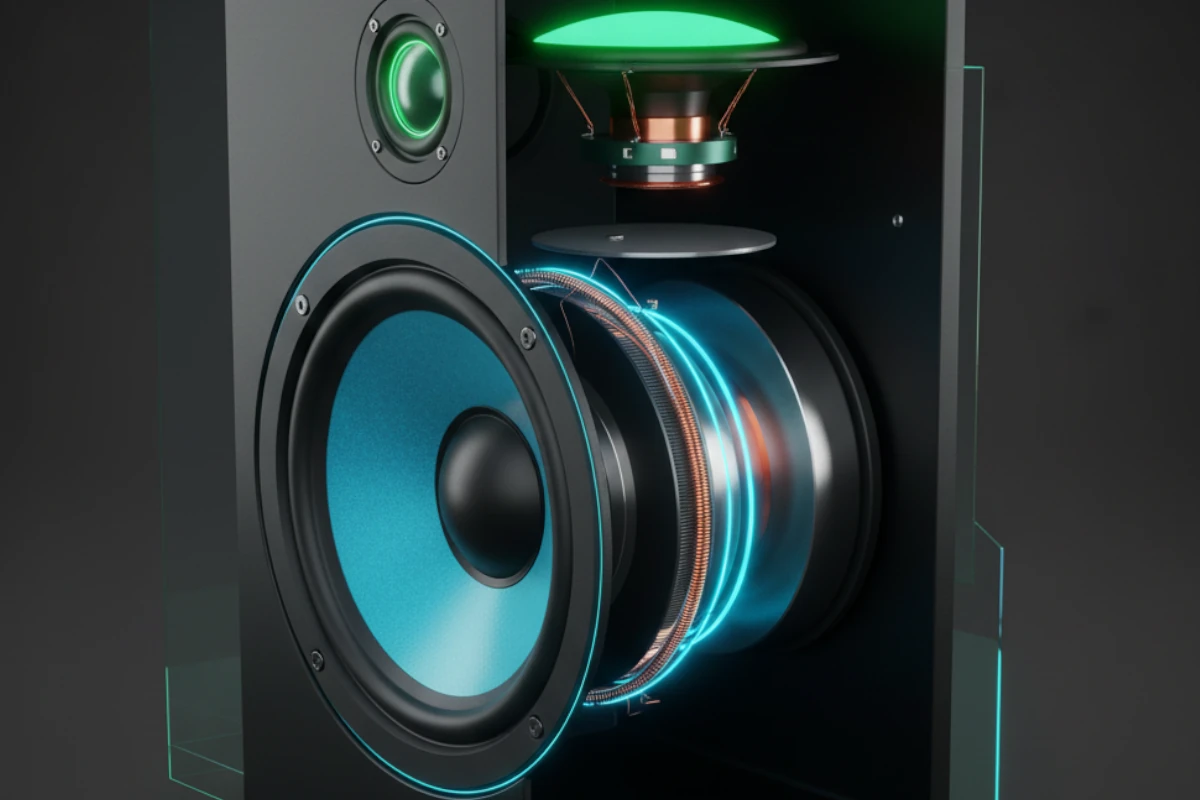
How speakers work:
Electrical signal → Voice coil → Magnet → Diaphragm moves → Sound
Components:
Diaphragm (cone): Moves air to create sound waves.
Voice coil: Wire wrapped around former that carries the signal.
Magnet: Creates magnetic field. Moves voice coil.
Frame (basket): Holds everything together.

How it works:
Why it matters:
Understanding speaker physics helps you understand:
This knowledge helps choose and place speakers.
Speaker types:
Woofers: Low frequencies. Large diaphragm.
Tweeters: High frequencies. Small diaphragm.
Full-range: All frequencies. One driver.
Why it matters:
Different speakers for different frequencies. Match to needs.
This knowledge helps design systems.
Practical connection:
Understanding speaker physics helps you troubleshoot. For distorted sound, check power handling. For no bass, check frequency response. For weak sound, check impedance matching.
This knowledge helps diagnose speaker problems.
Audio systems follow a path. Here's how.
Signal Flow
How audio moves:
Systems should follow this path efficiently.
Component Roles
Sources: Create audio signals.
Processors: Shape and adjust sound (if needed).
Amplifiers: Power the signal.
Speakers: Make sound audible.
Each component does its job.
System Architecture
What: How components connect.
Clean, efficient architecture ensures reliable sound.
Why it matters: Good architecture means reliable sound.
Physics in signal flow:
Signal travels as electricity. Electricity follows physics laws. Understanding physics helps you understand signal flow.
This knowledge helps design efficient systems.
Understanding physics helps you understand everything else.
What you can now understand:
Foundation for:
This foundation applies to all audio work.
Next steps:
Understanding these concepts helps you make informed decisions.
You now understand the physics. The science behind audio systems.
Key Takeaways:
What's next:
This foundation helps you understand:
This knowledge applies to all audio work.
Next post: Audio System Electronics (balanced/unbalanced, ground loops, troubleshooting) More topics: Connectors, and more